I’ve been thinking of the Dunning-Kruger Effect recently. It seems to fit reality, and my own experience, so well. The Dunning-Kruger effect defined is “The Dunning–Kruger effect is a cognitive bias in which people with limited competence in a particular domain overestimate their abilities,” according to Wikipedia. In other words, when we are new at something, we tend to over estimate our knowledge or expertise. We start with gusto, perhaps thinking our ideas or plans are amazing, only to find as experience takes place that we have much to learn.
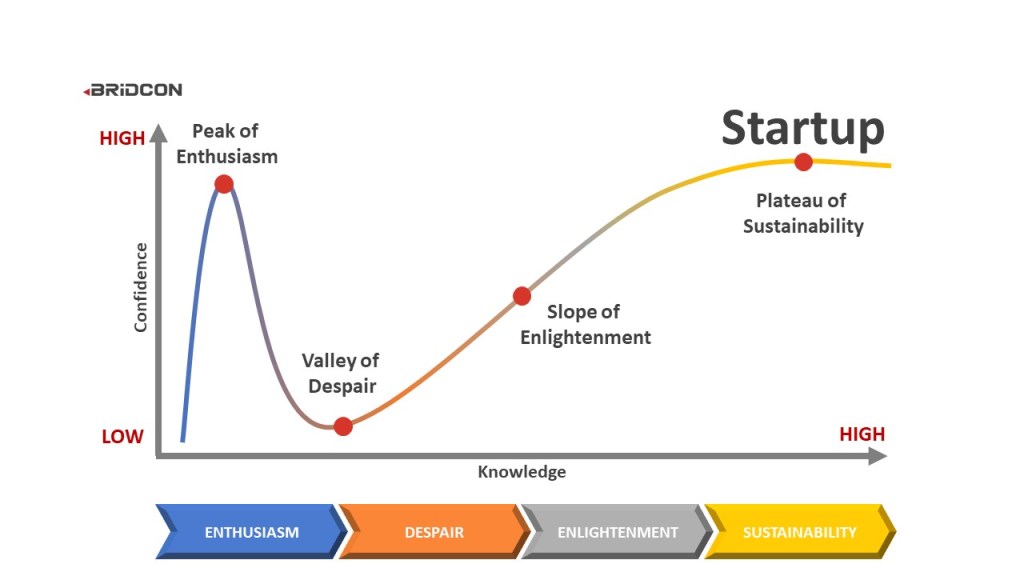
Following along the above chart, one starts out with high enthusiasm and confidence in our knowledge of a subject. We put our best foot forward, put on our best clothes, let people know our competencies. Then the results come in. Then we learn that we have much to learn, and when confronted by the vastness of a subject area, we may fall into despair or discouragement.
Many will pack it in at this point, “I didn’t know this was so hard!” With time we learn the knowledge base of a subject and we begin to see the depth and richness of a given subject. We begin to make connections we did not see before. We learn shortcuts as patterns are recognized and our efficiency increases. Eventually we stick to it and learn how to sustain ourselves in a profession or subject matter.
For example, you get a job in a new career field in the restaurant business. Seems simple! “I know how to make pizza, I’ll just do it my way and we will sell them like crazy.” Maybe you even have a good recipe that will help the business. The first day on the job at a restaurant will often humble someone, be it in the kitchen or waiting tables. Orders rush in and you cannot seem to put pepperonis on the pizza fast enough! People are waiting, yet you watch someone else put sauce on the pizza so much faster than you have ever seen. Their hands dip smoothly into the onions and spread them perfectly in an instant. I’ve seen people quit after one day because of the pace, pressure, or simply being by a hot oven for eight hours!
Over time, however, one learns the most efficient way to spread sauce. You learn the finer points of tossing dough and collaboration behind the pizza line. You learn when things tend to be busy and when things are slow so that you can keep up on preparation or cleaning. Camaraderie grows as you become one of the crew rather than the new person with all the ideas. Eventually you learn the recipe of the sauce and how to make it. Maybe even make a suggestion that works, but only after testing your expectations and ideas against reality.
How I wish I would have learned about this when I was younger! A measure of humility is often the best medicine when approaching something new. We may be eager to prove our worth in a new job, but over-extend and we can find ourselves in a worse mess. Even with the foreknowledge that we have much to learn starting out, we will foray into a new endeavor only to find we make mistakes. Without humility, our expectations can be dashed, sometimes quite thoroughly.
Another lesson is truth. Does your knowledge measure up to reality? Do your ideas play in the real world? Maybe other ideas are more tested and have better results. Even doing the same job in a new environment demands us to look at the truth of the matter. Different environments and people have slightly different processes even in the same field of work. The reality is that some of your skills will thrive and work to compensate for your lack of knowledge and experience. The truth hurts sometimes, but it is also our best friend towards personal growth.
The spiritual life seems to have similar patterns. People new to the spiritual life often have the fervor of a new convert. We absorb all we can about God or faith. We read the Bible with newfound eyes and are happy to accept the new principles as they come in. Then we leave the house and try to practice patience in the grocery line, tell the truth if it is to your disadvantage, and apologize when you wrong someone. It is easy to get discouraged because we fail often in the spiritual life!
The Apostle Paul wrote in 1 Corinthians 15:30-32, “30 Why are we in danger every hour? 31 I protest, brothers, by my pride in you, which I have in Christ Jesus our Lord, I die every day! 32 What do I gain if, humanly speaking, I fought with beasts at Ephesus? If the dead are not raised, “Let us eat and drink, for tomorrow we die.” Paul understood how tenuous life can be, and indeed our relationship with Christ happens in the day, in the moment. Paul would give up his life everyday and accept it as a gift to be lived for Christ and for his service.
Therefore it is important to know what we do not know, or at least, that we will never know everything. We are better served humbly asking daily “what is your will today” rather than assume we know what God wants. We can have good ideas about what we are to do, like chores, family, work, and so on. A life lived before God, however, is looking for God throughout our day rather than assuming we know.
Over time we learn more about ourselves and about faith, if we work at it everyday. Committing ourselves to learning about the spiritual life is a commitment that demands our full attention because the knowledge is found in scripture, self, and our daily experiences. For example, we learn stealing is wrong from scripture, upon self examination we discover where we may steal from others (maybe not overtly, but being less than honest with our fiances?), we then see in our daily life were we have opportunity to correct our course.
We are served by humility and truth as well. It takes humility to see what we know and what we think we know. It takes humility to accept our best efforts, while admirable, fall short of what we need. Truth reveals that our efforts to justify ourselves before God or others will never fully compensate for our mistakes. The truth be told, in the spiritual life, our efforts can be liabilities. God does the saving, the teaching, and gives the grace to try again. Jesus has already paid the price for our mistakes, and if we humbly accept this truth, we can begin our journey.
Over time we learn that the more we allow God to use us rather than for us to live in ourselves, the closer to God we can get. Through identification of our shortcomings, knowledge of God’s teaching, we get smaller and God gets bigger. We live life outside our own heads, motivated to help others for God’s sake, not for ours or our own needs. The more we see God will meet our needs, the more we are able to let go and allow our lives to be guided spiritually. This journey begins anew each day. If only we can keep the enthusiasm of a new believer with the humility of someone who has lived many years of faith!
 After The Work
Leave a comment